
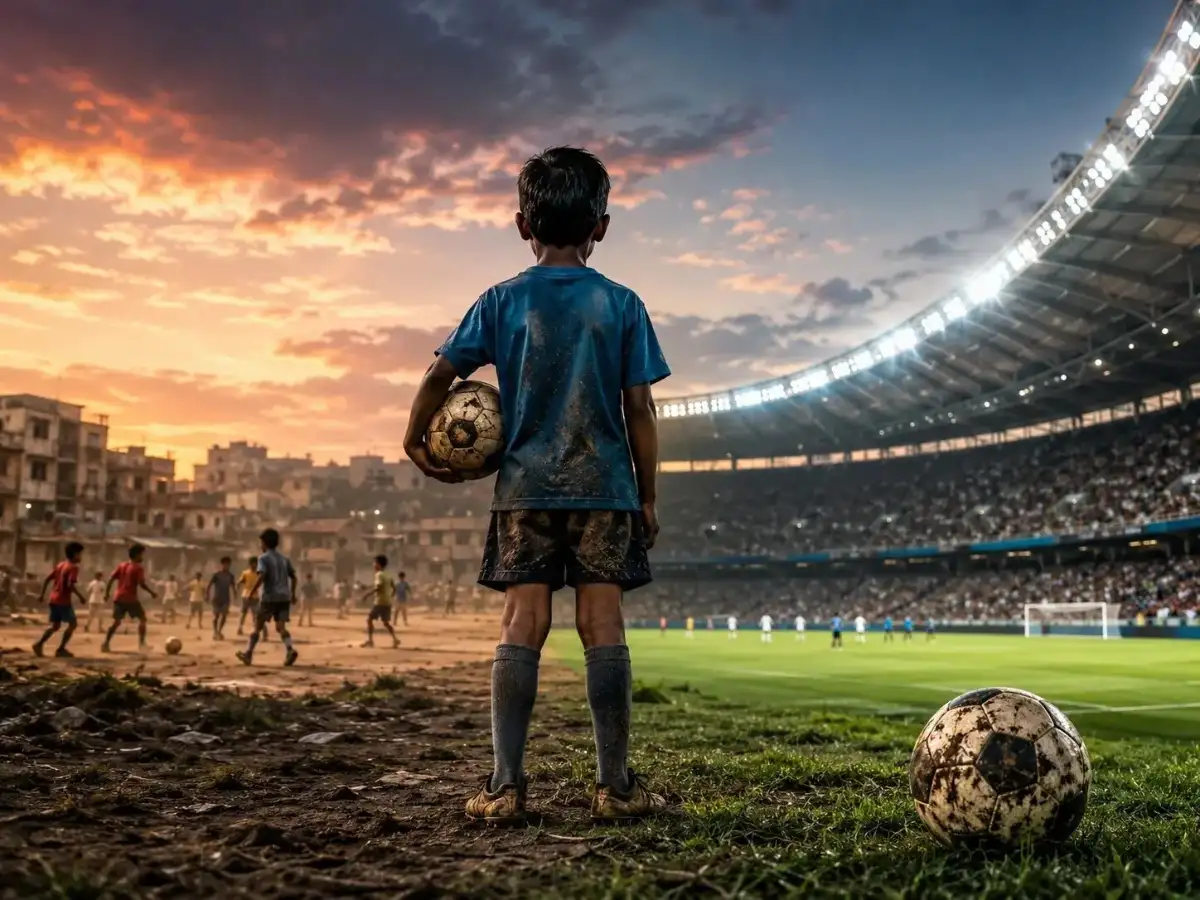
India does not need to discover football talent.
It needs to stop burying it.
How Tiny Islands Reached the World Cup While India Still Watches From Home
How does India, with 1.4 billion people, fail to make the FIFA World Cup while tiny Cabo Verde, an Atlantic archipelago of about half a million people, and Curaçao, a Caribbean island of roughly 156,000, reach football’s biggest stage?
The lazy answer is: cricket. The emotional answer is: bad luck. The official answer will usually be: we are improving, give us time. None of these is good enough.
The truth is sharper. India does not lack bodies. India lacks a football system. Talent exists, but it is scattered, under-coached, under-scouted, under-competed, and frequently crushed before it matures. Tiny nations qualify because they are small but organised. India remains huge but fragmented.
Cabo Verde and Curaçao are not fairy tales. They are football lessons. And India should be humble enough to learn from them.
The comparison that should make India uncomfortable
| Country / Team | Scale | Football status | What it proves |
|---|---|---|---|
| India | 1.4+ billion people; FIFA men’s ranking listed as 141 on AIFF’s June 2026 homepage | Did not qualify for the 2026 World Cup | Population does not become football strength automatically. |
| Cabo Verde / Cape Verde | About 500,000+ people; 10 islands off West Africa; around 4,033 sq km | Qualified for its first World Cup and drew with Spain and Uruguay in 2026 | Small nation, clear identity, diaspora strength, disciplined rise. |
| Curaçao | Around 156,000 people; about 444 sq km | Smallest country ever to qualify; earned a 0-0 World Cup draw with Ecuador | Dutch football ecosystem plus diaspora can beat demographic disadvantage. |
The expanded 48-team World Cup gave more countries a doorway. But it did not carry them through the doorway. Cabo Verde still had to top a qualifying group. Curaçao still had to survive Concacaf qualification. India did neither.
India’s 2026 qualifying failure was not one bad night.
India finished third in its second-round qualifying group behind Qatar and Kuwait, and ahead of Afghanistan. The record was grim: one win, two draws and three losses. Worse, India scored only three goals in six matches. That is not a refereeing problem. That is an output problem.
Yes, the match against Qatar had controversy. But serious football nations do not build a national diagnosis around one refereeing decision. India had six matches to prove it belonged in the next round. It did not.
A national team that cannot score regularly against Asian qualifying opponents is not “unlucky.” It is underpowered.
Why the tiny nations are not tiny in football terms
1. They use diaspora intelligently
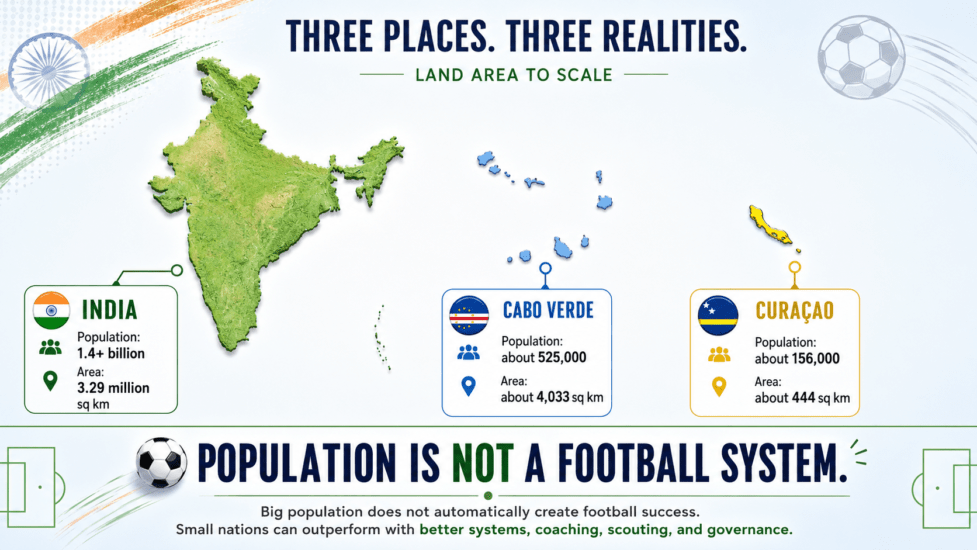
Cabo Verde’s football identity extends into Portugal, France, the Netherlands, Belgium and other European systems. Curaçao’s pipeline is deeply connected to Dutch football. Many of their players are not merely “from” these islands in sentimental terms; they are professionally trained in stronger football environments and then choose to represent their ancestral homeland.
That is the first big lesson: small countries can become large football countries if their player pool is global.
India has a vast global diaspora. Yet Indian football has not built a serious, aggressive, technically competent worldwide scouting operation for eligible Indian-origin talent. We export people. We do not import football quality.
2. Their footballers enter competitive ecosystems early
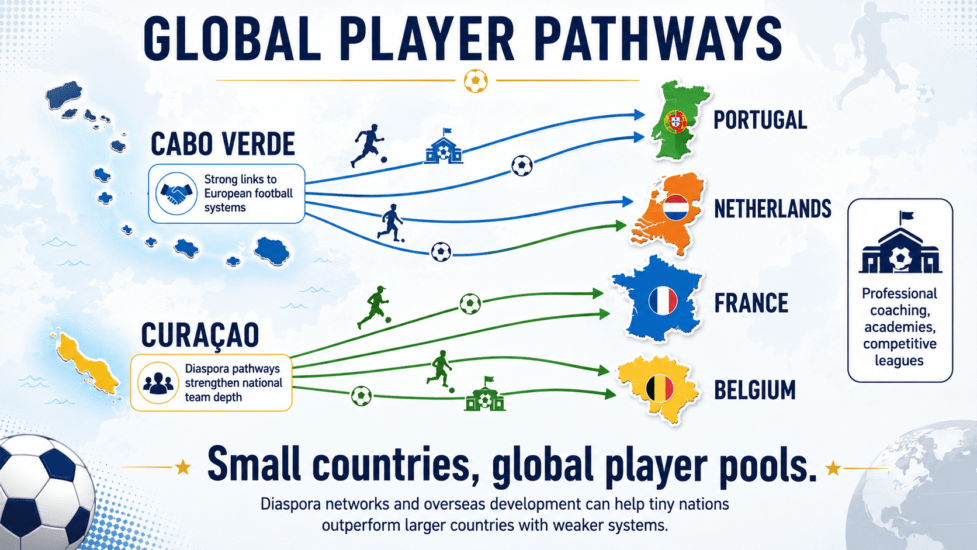
A Cabo Verdean-origin or Curaçao-origin player developed in Portugal or the Netherlands grows up with better youth coaching, academy discipline, competitive match minutes, tactical education, nutrition, physical conditioning and sports science.
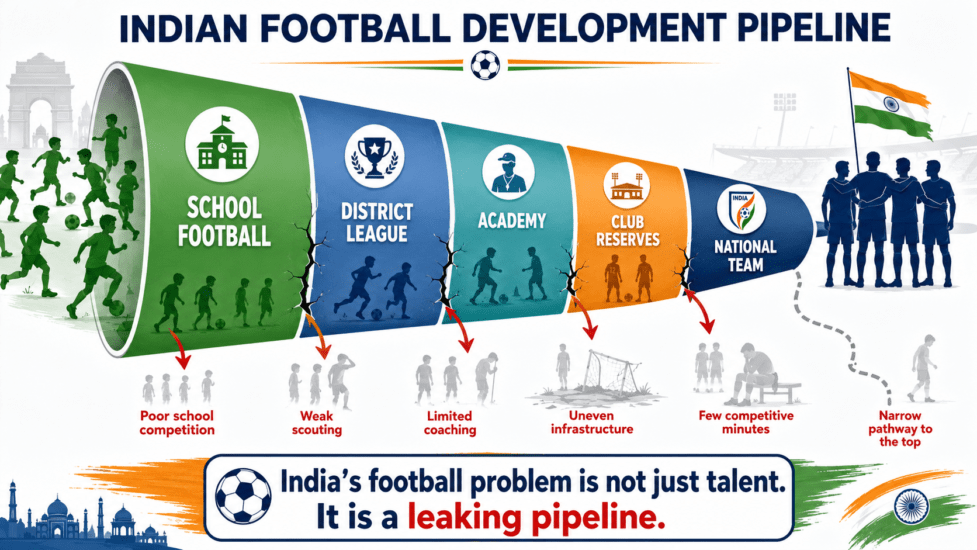
An Indian child, even if talented, often faces poor school-level competition, uneven local coaching, bad pitches, weak scouting, family pressure toward safer careers, and no obvious road from age 10 to professional football.
This is how talent dies in India: quietly, locally, and without an obituary.
3. They know exactly how they must play
Small teams cannot afford fantasy football. They build identity. They defend compactly, counter fast, attack set-pieces, press selectively, and pick players for roles. Their coaches often understand the limits of the squad and build a practical plan.
India too often looks like a team trying to “compete” without having enough weapons. We are not technically elite. We are not physically dominant. We are not tactically ruthless enough. That leaves us in the worst football zone: hardworking but harmless.
What actually ails Indian football?
1. Governance: the original disease
The Supreme Court’s 2025 AIFF judgment did not mince words. It observed that AIFF failed to evolve with time, struggled to manage Indian football efficiently, and that Indian football became affected by politics and regionalism. It also quoted commentary pointing to corruption, lack of professionalism, factionalism, favouritism and infighting in Indian football administration.
That is not angry fan talk. That is the country’s highest court looking at the state of football administration and saying, in effect: this is not good enough.
When governance is weak, everything below it becomes weak: league planning, youth competitions, coaching education, refereeing, club licensing, scouting, sports science, commercial rights and investor confidence.
Indian football has not been run like a serious football project. Too often it has been run like a federation-politics-commercial-rights compromise.
2. Political and legal interference: instability dressed as reform
In 2022, FIFA suspended the AIFF because of “undue third-party influence.” The suspension was lifted only after FIFA received confirmation that the Committee of Administrators’ mandate had ended and AIFF had regained control of its daily affairs.
This does not mean reform was unnecessary. Reform was necessary. But football governance has a hard rule: national federations must remain independent under FIFA statutes. India managed to fall into the worst middle ground: bad old governance, court intervention, FIFA pressure, and institutional uncertainty.
A serious football nation cannot keep lurching from committee to court to suspension to temporary compromise.
3. League instability: you cannot build a national team on a wobbling league
The Indian Super League was put on hold in 2025 because of unresolved negotiations over the AIFF-FSDL commercial agreement, with Supreme Court proceedings around the AIFF constitution also affecting renewal discussions. FIFPRO publicly expressed concern about the uncertainty and its impact on players.
Reports later noted continued uncertainty around the league structure, ownership model and start dates. Even in June 2026, AIFF was still discussing a possible club-led model and even a name change, while the World Cup was already under way.
This is the kind of thing that makes serious football people shake their heads. You cannot ask clubs, players, sponsors, broadcasters and fans to believe in a football pyramid if the top league itself is repeatedly unstable.
4. Grassroots: too much slogan, too little system
AIFF has development programmes, youth leagues, scouting efforts and academy references. On paper, the language is encouraging. But output matters more than PowerPoint.
India is still not producing enough elite footballers for Asian level, let alone World Cup level. The gap between “we have a programme” and “we produce players” remains huge.
A football country is not built by announcing initiatives. It is built by recording how many children play structured football, how many qualified coaches train them, how many competitive matches they play, how many academies are audited, how many players move from U-13 to U-17 to U-21 to professional clubs, and how many become international-quality footballers.
5. India has players, but not enough footballers
This sounds harsh, but it is important. A player can run, tackle, shoot and train hard. A footballer scans before receiving, controls under pressure, understands space, changes tempo, makes third-man runs, presses intelligently, and plays 35 to 45 competitive matches a year.
India produces many enthusiastic players. It produces too few complete footballers.
The national coach cannot repair a 15-year-old’s first touch. The senior team cannot fix what the youth system failed to build.
6. Cricket is not the excuse. It is the mirror.
Many people say Indian football suffers because India is a cricket country. That is lazy. Cricket shows the opposite: India can build a world-class sporting ecosystem when money, administration, coaching, competition, media, aspiration and commercial incentives align.
So the real question is not “why does cricket dominate?” The real question is: why has football failed to create even one strong, scalable, credible development pipeline despite India’s size?
The diagnosis, without soft language
| Question | Blunt answer | Comment |
|---|---|---|
| Is talent absent? | No. It is wasted. | Raw talent without coaching, competition and scouting is just potential energy. |
| Is administration the biggest failure? | Yes. | Governance is the root disease. Everything else grows from it. |
| Is political interference a problem? | Yes, but broader than party politics. | The real issue is institutional capture, factionalism and instability. |
| Is money the issue? | Partly. More important is smart money. | Visibility without player development creates entertainment, not excellence. |
| Is coaching weak? | Yes, especially at youth level. | India needs thousands of better coaches, not just one foreign national coach. |
| Is the league structure good enough? | No. | A credible football nation needs a stable calendar, pyramid and club pathway. |
The Cape Verde-Curaçao lesson for India
Cabo Verde and Curaçao are not better because they are bigger, richer or more populous. They are better because their national teams are connected to functioning football cultures and professional player-development systems beyond their borders.
India’s player pool is largely domestic and underdeveloped. Cabo Verde and Curaçao can select players shaped by Portuguese, Dutch and other European football environments.
Here is the uncomfortable one-line summary:
Cabo Verde and Curaçao import football excellence through diaspora. India exports population but does not import football quality.
What India must do now
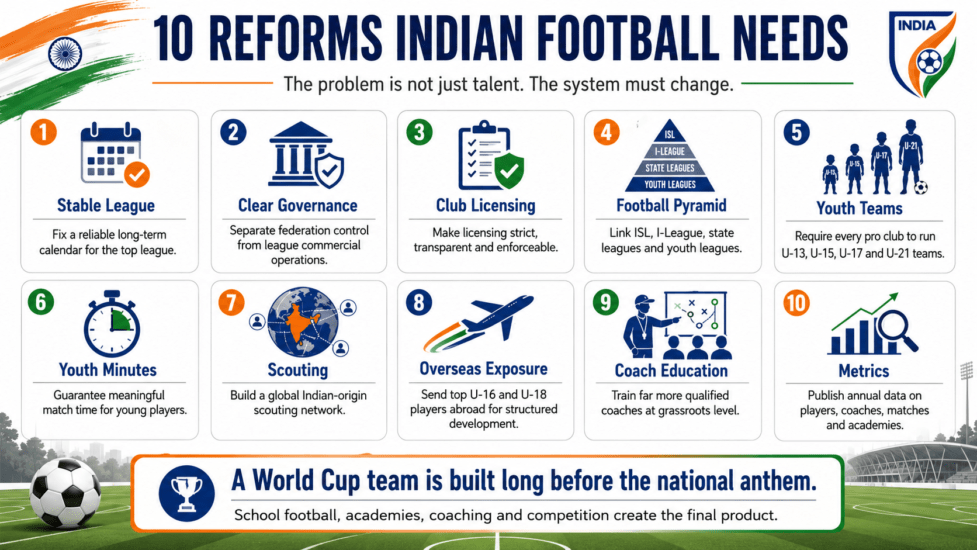
No drama. No more excuses. No more “Vision 2047” wallpaper unless the machinery underneath changes. India needs football reform that can be measured every year.
Stabilise the top league calendar for at least 10 years.
Separate federation governance from league commercial operations with clear accountability.
Make club licensing strict, transparent and enforceable.
Create a genuine football pyramid linking ISL, I-League, state leagues and youth leagues.
Force every professional club to run serious U-13, U-15, U-17 and U-21 teams.
Mandate meaningful youth minutes in domestic competitions.
Build a global Indian-origin scouting cell across Europe, North America, Africa and the Gulf.
Send the best U-16 and U-18 players abroad for structured exposure, not photo-op tours.
Invest massively in coach education at district and academy level.
Publish annual football development metrics: registered players, certified coaches, youth matches, academy audits, player progression and national-team conversions.
The one reform that matters most
India must stop treating the national team as the starting point. The national team is the final product. The factory is school football, district leagues, state leagues, youth academies, club reserves, sports science, coaching quality and competitive minutes.
Right now, the factory is broken — and we keep repainting the showroom.
That is why tiny islands can reach the World Cup while India watches on television. Their player pathways may be small, but they are connected. Our player pool is enormous, but our pathway is broken.
India does not need to discover football talent. It needs to stop burying it.
@jsvasan